
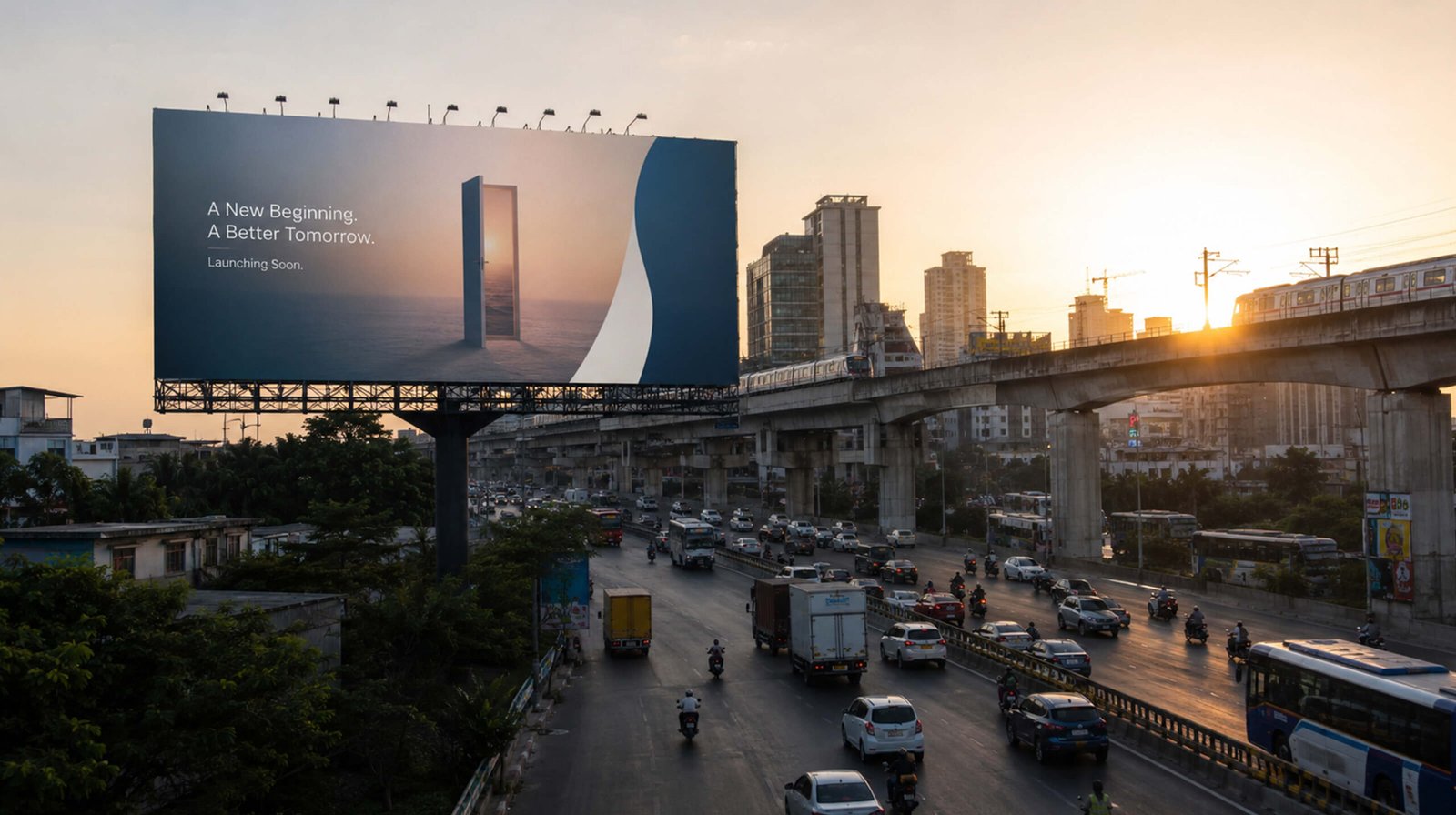
When businesses plan their marketing budget, one of the first questions they ask is, “How much does outdoor advertising cost in India?” Whether you’re launching a new brand, opening a retail outlet, promoting a real estate project, or expanding into new cities, understanding the cost of hoardings and billboards is essential for making informed marketing decisions.
Outdoor advertising has long been one of the most effective ways to build brand awareness. Unlike digital ads that disappear with a swipe or can be skipped entirely, hoardings and billboards remain visible to thousands of people every day. They create repeated exposure, strengthen brand recall, and help businesses establish a strong presence in high-traffic areas.
However, the cost of outdoor advertising isn’t fixed. It depends on several factors, including the location, size of the display, type of media, campaign duration, and audience reach. A billboard in a busy metropolitan city like Mumbai or Bengaluru will naturally have different pricing than one in a Tier-2 city. Similarly, digital billboards and premium transit advertising may require a different investment compared to traditional hoardings.
The good news is that outdoor advertising isn’t limited to large corporations. Today, startups, local businesses, educational institutions, hospitals, restaurants, and SMEs are increasingly using OOH (Out-of-Home) advertising to reach their target audiences effectively. With the right planning and the right advertising partner, businesses of all sizes can run impactful campaigns that fit their marketing goals and budget.
In this guide, we’ll break down the factors that influence outdoor advertising costs in India, explain how pricing works, and share practical tips to help you maximize the value of your investment.
What Is Outdoor Advertising?
Outdoor advertising, also known as Out-of-Home (OOH) advertising, refers to promotional messages displayed in public spaces where people travel, shop, work, or spend time.
Common forms of outdoor advertising in India include:
- Static hoardings
- Highway billboards
- Digital LED billboards
- Transit advertising (buses, metro trains, taxis)
- Bus shelter advertising
- Airport advertising
- Mall media
- Pole kiosks and street furniture
- Wall wraps and building facades
The objective is simple: place your brand in front of people during their daily routines, creating consistent visibility and increasing the chances of brand recall.
Why Outdoor Advertising Continues to Deliver Strong Value
Even with the rapid growth of digital marketing, outdoor advertising remains one of the most trusted and effective branding channels. Here’s why:
1. Uninterrupted Visibility
Outdoor advertisements can’t be skipped, blocked, or closed. A strategically placed hoarding remains visible 24 hours a day throughout the campaign period.
2. Broad Audience Reach
High-traffic roads, commercial districts, metro stations, and airports expose your brand to thousands—or even millions—of people over time.
3. Strong Brand Recall
Repeated exposure helps customers remember your business when they’re ready to make a purchase.
4. Local and Regional Targeting
Outdoor advertising allows businesses to focus on specific cities, neighborhoods, or travel routes, making it an excellent option for localized marketing.
5. Complements Digital Campaigns
Many businesses combine outdoor advertising with Google Ads and social media campaigns, creating multiple touchpoints that strengthen customer engagement.
What Determines Outdoor Advertising Costs in India?
There isn’t a single price for billboard or hoarding advertising. Instead, several factors influence the final investment.
1. Location
Location is one of the biggest pricing factors.
A billboard in a busy commercial area with high daily traffic generally commands a higher price than one in a less populated area. Prime locations often provide greater visibility, making them attractive for businesses aiming to maximize brand exposure.
Examples of premium locations include:
- Major highways
- City entry and exit points
- Central business districts
- Shopping malls and commercial hubs
- Airport approach roads
- Metro stations
- High-footfall intersections
Choosing the right location isn’t just about visibility—it should also align with your target audience.
2. Size of the Hoarding or Billboard
Larger displays naturally attract more attention and provide greater creative space. However, bigger isn’t always better. The ideal size depends on viewing distance, traffic speed, and campaign objectives.
For example:
| Billboard Type | Typical Use |
|---|---|
| Small Local Hoarding | Neighborhood promotions |
| Medium Billboard | City campaigns |
| Large Highway Billboard | Regional or national brand awareness |
| Digital LED Billboard | Dynamic campaigns and multiple creatives |
3. Campaign Duration
Outdoor advertising campaigns are generally booked for weeks or months.
Longer campaign durations often provide better value because they allow for repeated exposure and stronger brand recall.
Businesses planning product launches or seasonal campaigns should ensure the campaign runs long enough for the audience to notice and remember the message.
4. Type of Outdoor Media
Different outdoor advertising formats have different pricing structures.
For example:
- Traditional hoardings
- Digital LED billboards
- Transit media
- Airport advertising
- Mall advertising
- Bus shelters
Each medium offers unique advantages depending on your marketing objectives, audience, and budget.
5. Traffic and Audience Demographics
Not all traffic is equal.
A location frequented by your ideal customers may deliver better results than a busier location with a less relevant audience.
When evaluating a location, consider:
- Daily vehicle traffic
- Pedestrian footfall
- Nearby commercial activity
- Residential population
- Business districts
- Educational institutions
- Shopping destinations
The goal is to reach the people most likely to become your customers—not simply the largest number of people.
Should Businesses Focus Only on Cost?
One of the biggest mistakes businesses make is choosing outdoor advertising solely based on price.
A lower-cost location may save money initially but fail to generate meaningful visibility if it doesn’t reach the right audience.
Instead of asking, “Which billboard is the cheapest?”, ask:
- Does this location reach my target customers?
- Is the billboard clearly visible?
- How much daily traffic passes this location?
- Does the campaign support my overall marketing goals?
- Will repeated exposure strengthen my brand?
The best outdoor advertising campaigns balance budget with strategic location selection, creative design, and campaign duration.
Planning Your Outdoor Advertising Budget
Every business has different marketing objectives, so there’s no universal budget.
A practical approach is to define:
- Your campaign objective.
- Your target audience.
- The cities or regions you want to reach.
- The campaign duration.
- The advertising formats that best support your goals.
Working with an experienced outdoor advertising partner can help identify opportunities that align with your budget while maximizing visibility.
Outdoor Advertising Costs in Metro Cities vs Tier-2 and Tier-3 Cities
One of the most common questions businesses ask is whether they should advertise in metropolitan cities or focus on Tier-2 and Tier-3 markets. The answer depends entirely on your business objectives, target audience, and marketing budget.
Metro cities such as Mumbai, Delhi NCR, Bengaluru, Hyderabad, Chennai, Kolkata, and Pune offer massive daily traffic, higher brand exposure, and access to diverse consumer groups. These cities are ideal for national brands, product launches, premium services, and businesses looking to build large-scale awareness.
However, increased visibility often comes with higher advertising costs due to the demand for premium locations.
On the other hand, Tier-2 and Tier-3 cities have become increasingly attractive for businesses. Cities like Vijayawada, Visakhapatnam, Coimbatore, Indore, Lucknow, Surat, Nagpur, Kochi, Mysuru, Rajahmundry, Warangal, and Bhubaneswar are experiencing rapid economic growth, increasing disposable incomes, and expanding urban infrastructure.
Advertising in these markets often allows businesses to achieve excellent visibility while working with more flexible budgets.
Instead of thinking about metro cities versus smaller cities as a competition, businesses should evaluate where their customers are located. A regional business serving Andhra Pradesh, for example, may benefit more from a well-planned campaign across cities such as Vijayawada, Guntur, Kakinada, Rajahmundry, and Visakhapatnam than from a single premium billboard in Mumbai.
The right strategy always depends on your audience—not just the city’s population.
How to Estimate the ROI of Outdoor Advertising
Unlike digital advertising, where clicks and impressions are measured instantly, outdoor advertising contributes to both direct and indirect business growth.
This doesn’t mean its impact cannot be measured. In fact, businesses can evaluate campaign performance using several practical methods.
Track Brand Searches
One of the simplest indicators of campaign success is an increase in online searches for your business name.
If people repeatedly notice your billboard, many will search for your company online to learn more.
Monitoring branded search traffic through analytics tools can help measure this increase.
Dedicated Landing Pages
Businesses can create campaign-specific landing pages for outdoor advertisements.
For example:
www.yourcompany.com/summeroffer
This makes it easier to identify how many website visitors arrived after seeing the campaign.
QR Codes
Many modern hoardings now include QR codes.
Customers can scan the code to:
- Visit your website
- Download a brochure
- View project details
- Register for an event
- Contact your business
QR codes provide measurable engagement while keeping billboard designs clean and simple.
Unique Phone Numbers
Another effective strategy is assigning a dedicated phone number to the campaign.
This helps businesses identify enquiries generated specifically through outdoor advertising.
Customer Feedback
Sometimes the simplest method is the most effective.
Train your sales team to ask:
“How did you hear about us?”
Many businesses discover that customers remember seeing their billboard weeks before making contact.
Common Myths About Outdoor Advertising Costs
Several misconceptions prevent businesses from exploring outdoor advertising.
Let’s address a few of the most common ones.
Myth 1: Outdoor Advertising Is Only for Large Brands
Reality:
Many startups, local businesses, educational institutions, hospitals, clinics, restaurants, gyms, and retail stores successfully use outdoor advertising.
Campaigns can be planned according to business goals and available budgets.
Myth 2: Bigger Billboards Always Deliver Better Results
Reality:
A billboard’s effectiveness depends on visibility, audience relevance, message clarity, and location—not just its size.
A well-positioned medium-sized hoarding near your target customers may outperform a larger display in an unrelated area.
Myth 3: Outdoor Advertising Cannot Be Measured
Reality:
Modern campaigns can be evaluated using:
- Website traffic
- QR code scans
- Call tracking
- Store visits
- Customer surveys
- Search trends
Outdoor advertising has become increasingly measurable when integrated with digital marketing.
Myth 4: Outdoor Advertising Is Too Expensive
Reality:
Costs vary depending on campaign objectives.
Businesses don’t need to begin with city-wide campaigns.
Starting with one or two strategic locations can create significant awareness while allowing companies to evaluate campaign performance before expanding further.
How to Maximize Your Outdoor Advertising Budget
Every marketing investment should generate value.
Fortunately, businesses can improve campaign performance without simply increasing spending.
Choose Strategic Locations
Instead of selecting the busiest road, identify locations frequently used by your target audience.
For example:
- Hospitals should advertise near residential communities and healthcare corridors.
- Educational institutions may focus on routes used by students and parents.
- Retail brands often benefit from shopping districts and commercial centres.
- Real estate developers should prioritize roads leading to their projects.
Location relevance often matters more than overall traffic volume.
Keep the Design Simple
Outdoor advertising is viewed for only a few seconds.
Successful billboards typically include:
- One strong headline
- High-quality visuals
- Clear branding
- Limited text
- Easy-to-read typography
- A simple call-to-action
Trying to communicate too much information reduces readability.
Maintain Campaign Consistency
Outdoor advertising works best through repeated exposure.
Businesses should avoid frequently changing creatives unless promoting time-sensitive offers.
Consistent branding strengthens recognition and improves recall.
Combine Outdoor Advertising with Digital Marketing
Outdoor advertising becomes even more effective when supported by digital campaigns.
For example:
- Someone notices your billboard.
- Later, they search for your business online.
- They encounter your Google advertisement.
- They follow your social media page.
- Finally, they contact your business.
This multi-channel approach creates stronger customer confidence throughout the buying journey.
Industries That Benefit Most from Outdoor Advertising
Almost every industry can benefit from increased visibility, but outdoor advertising is particularly effective for businesses that rely on brand awareness and local presence.
These include:
Real Estate
Project launches, apartment sales, villa communities, and commercial developments.
Healthcare
Hospitals, diagnostic centres, speciality clinics, and wellness services.
Retail
Fashion brands, supermarkets, electronics stores, furniture showrooms, and lifestyle brands.
Education
Schools, colleges, coaching institutes, universities, and skill development centres.
Hospitality
Hotels, restaurants, cafés, resorts, and event venues.
Automobile
Car dealerships, bike showrooms, EV brands, and automobile service centres.
Financial Services
Banks, insurance providers, fintech companies, and investment firms.
Startups
Technology companies, D2C brands, SaaS businesses, healthcare startups, and consumer brands looking to establish local credibility.
One of the strengths of outdoor advertising is its flexibility. Businesses can begin with focused campaigns and expand as their marketing goals evolve.
Common Mistakes Businesses Make When Launching a Billboard Campaign
Even the most attractive billboard cannot deliver the desired results if the campaign is not planned correctly. Many businesses invest in outdoor advertising with high expectations but overlook key planning factors that significantly influence campaign performance.
Understanding these common mistakes can help you create a more effective and result-oriented campaign.
Mistake 1: Focusing Only on Cost Instead of Value
One of the biggest misconceptions is choosing a billboard simply because it is less expensive.
While staying within budget is important, selecting a location based only on price can limit your campaign’s visibility. A strategically positioned hoarding that reaches your target audience consistently often delivers greater value than a cheaper location with lower visibility.
Instead of asking:
“Which billboard is the cheapest?”
Ask:
- Does this location reach my ideal customers?
- Will people notice my advertisement?
- Does this location align with my campaign goals?
- Is my brand likely to be remembered after repeated exposure?
The goal is not just to advertise—it is to advertise where it matters.
Mistake 2: Trying to Say Too Much
A billboard is not a brochure.
Many businesses try to include:
- Multiple headlines
- Long paragraphs
- Numerous product images
- Several offers
- Too many contact details
This overwhelms viewers.
Remember, most people have only a few seconds to absorb your message while walking or driving past.
A successful hoarding advertisement usually communicates one clear idea.
For example:
- One headline
- One striking visual
- One brand logo
- One website or phone number
Simple messages are easier to remember.
Mistake 3: Ignoring Campaign Duration
Outdoor advertising works through repeated exposure.
A campaign that runs for only a very short period may not give enough people the opportunity to notice and remember your brand.
Consistency is what builds recognition.
Depending on your campaign objective, maintaining visibility over several weeks or months often creates stronger brand recall than a short campaign.
Mistake 4: Choosing the Wrong Location
A billboard placed in a busy area is not automatically the right billboard.
For example:
- A local retail business should prioritize locations near shopping districts or residential areas.
- A commercial project may benefit from visibility along business corridors.
- A service-based company may focus on routes frequently used by its target customers.
The most effective location is one that connects your message with the audience most likely to respond.
Mistake 5: Treating Outdoor Advertising as a Standalone Activity
Outdoor advertising is powerful on its own, but it becomes even more effective when combined with other marketing channels.
A customer may:
- Notice your billboard while commuting.
- Search for your business online later that evening.
- Visit your website.
- Follow your social media pages.
- Contact your business after comparing your services.
This integrated journey demonstrates why outdoor advertising and digital marketing work best together rather than competing with each other.
Outdoor Advertising vs Digital Marketing: Why Businesses Need Both
Businesses often ask whether they should invest in outdoor advertising or digital marketing.
The better question is:
How can both channels work together?
Each serves a different purpose within the customer journey.
| Outdoor Advertising | Digital Marketing |
|---|---|
| Builds brand awareness | Captures active interest |
| Creates repeated offline visibility | Drives measurable online engagement |
| Reaches people during daily travel | Reaches users on phones and computers |
| Strengthens brand recall | Encourages enquiries and conversions |
| Establishes local presence | Supports remarketing and follow-up campaigns |
Rather than replacing one another, these channels complement each other.
Outdoor advertising introduces your brand in the real world, while digital marketing helps interested customers learn more and take action.
For many businesses, this combination creates a stronger and more memorable brand experience.
How to Measure the Success of a Billboard Campaign
Although outdoor advertising focuses heavily on awareness, businesses can still evaluate campaign performance using practical methods.
Monitor Website Traffic
Many customers who see a billboard later search for the company online.
An increase in direct website visits or branded searches during the campaign period can indicate growing awareness.Use a Dedicated Landing Page
Instead of directing customers only to your homepage, create a campaign-specific landing page.
This makes it easier to understand how outdoor advertising contributes to website engagement.Include a QR Code
Modern billboard designs often include a QR code that allows people to:
- Visit your website
- Download a brochure
- View product information
- Submit an enquiry
This creates a direct connection between offline advertising and online interaction.
Track Customer Enquiries
Sales teams should regularly ask new customers:
“How did you hear about us?”
Over time, this simple question provides valuable insights into which marketing channels are generating awareness.
Evaluate Brand Recall
Not every campaign leads to immediate sales.
Sometimes the biggest success is becoming a familiar name within your target market.
If more people recognize your business after the campaign, your outdoor advertising has achieved one of its most important objectives.
Outdoor Advertising Trends Businesses Should Watch
The outdoor advertising industry continues to evolve alongside technology and changing consumer behaviour.
Some important trends include:
Digital Out-of-Home (DOOH)
Digital displays allow advertisers to update creatives quickly and schedule messages for different times of the day.
Data-Informed Planning
Businesses increasingly use traffic insights and audience information to select locations that better match their target customers.
Integrated Campaigns
Outdoor advertising is increasingly planned alongside search marketing, social media, content marketing, and public relations to create a consistent brand presence.
Creative Simplicity
Modern billboard design is moving toward cleaner layouts, stronger visuals, and shorter messages that can be understood within seconds.
Frequently Asked Questions
1. Is outdoor advertising suitable for startups?
Yes. Outdoor advertising can help startups introduce their brand to local audiences, build credibility, and increase awareness. Campaigns can be planned according to available budgets and business goals.
2. How long should a billboard campaign run?
Campaign duration depends on your objectives, but maintaining visibility over several weeks generally provides better opportunities for repeated exposure and stronger brand recall.
3. What makes a billboard effective?
An effective billboard combines a strategic location, a simple message, clear visuals, readable typography, and consistent branding.
4. Can outdoor advertising support digital marketing?
Absolutely. Outdoor advertising creates awareness, while digital channels provide opportunities for customers to explore your products or services in more detail.
5. Should businesses advertise in one city or multiple cities?
This depends on your target audience and expansion plans. Many businesses begin with focused regional campaigns before scaling into additional markets.
6. Is outdoor advertising only useful for large companies?
No. Businesses of all sizes can benefit from outdoor advertising when campaigns are carefully planned and aligned with their objectives.
Conclusion
In today’s competitive business environment, visibility is one of the most valuable assets a brand can build. While marketing channels continue to evolve, outdoor advertising remains a reliable way to place your business in front of potential customers during their everyday lives.
A well-planned billboard campaign is more than a marketing activity—it is an investment in long-term brand recognition. By selecting the right locations, designing clear and memorable creatives, and integrating outdoor advertising with your broader marketing strategy, businesses can create meaningful visibility that supports sustainable growth.
Whether you’re introducing a new business, promoting a product, expanding into new markets, or strengthening your local presence, outdoor advertising provides an opportunity to remain visible where your audience lives, works, and travels.
The key is not simply placing a hoarding—it is planning a campaign with purpose, understanding your audience, and delivering a message that people remember.
How Mahi Hoardings Can Support Your Outdoor Advertising Journey
Every business has different marketing goals, target audiences, and budgets. That’s why successful outdoor advertising begins with understanding your objectives before selecting advertising media.
At Mahi Hoardings, we work with businesses to identify suitable outdoor advertising opportunities, recommend strategic locations, and help plan campaigns that align with their branding and marketing goals. Whether you’re planning a local campaign or expanding into multiple cities, thoughtful planning can make a significant difference in building brand visibility.
If you’re exploring outdoor advertising for your next campaign, our team is ready to help you develop a strategy that supports your long-term business growth.